Howdy,
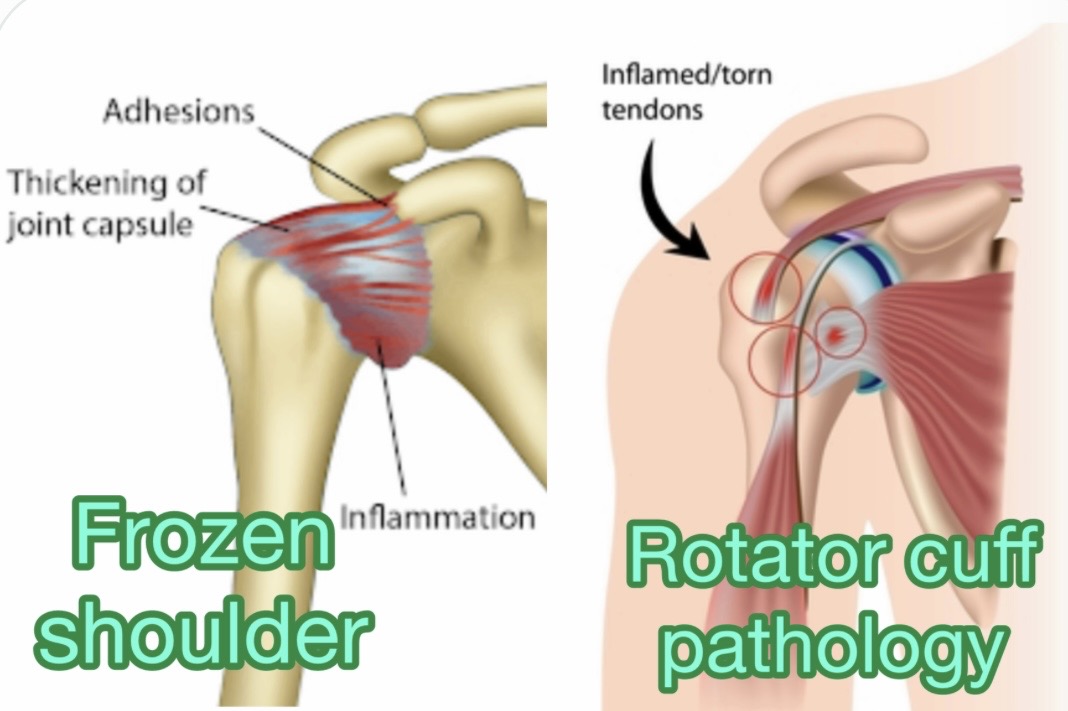
We are aware though that there are exceptions to all this, but, usually, from a range of motion perspective, frozen shoulder causes a global restriction of both active and passive ROM, whereas rotator cuff pathology typically causes a limitation in active ROM due to pain or weakness, while passive ROM is usually preserved – which often can be noticed during assessment (unless the subacromial bursitis is involved, which is often in relation to rorator cuff pathology).
People with frozen shoulder progressively lose range of motion rapidly, and it is very painful. In most cases, people with rotator cuff pathology lose more shoulder internal rotation (IR), depending on pathology though, and experience more pain at end-range IR, but people with frozen shoulder commonly lose more external rotation (ER). However, in both cases, there’s reduction and pain when it comes to active abduction (ABD), in most cases.
Frozen shoulder is a clinical enigma. It’s a very sore and stiff shoulder. It is very likely a complex systemic immuno-metabolic condition with not one clear cause and solution. For example, a person around 50 years of age, has issues at least a month, at least 50% reduction of active and passive ER, compared to not affected arm.
Females are more likely to develop frozen shoulder, although it’s unclear whether hormonal changes during menopause are a major contributing factor. In contrast, diabetic men appear to be at higher risk…
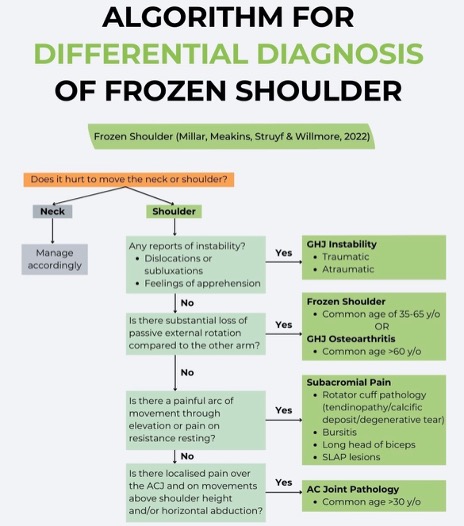
Last but not least, if shoulder hurts during the evening and during sudden changes of arm position (plus progressively losing active and passive shoulder ROM, especially ER), we might start thinking about frozen shoulder… In general, diagnosing it isn’t easy – because symptoms are very similar to various shoulder issues (including RCRSP)… Surgical treatment for this condition is usually useless. Below, you can see the algorithm for differential diagnosis of frozen shoulder…
When it comes to the general population, rotator cuff problems commonly begin to appear after the age of 40, and it’s considered a normal aging condition/process that rarely requires surgical treatment (often asymptomatic, e.g. many people can have a rotator cuff tear shown on the scan without even knowing it because they are symptomless – particularly athletes, this is a strong proof how complex and mysterious pain is).
Full recovery of tougher rotator cuff issues often requires 3-6 months, but frozen shoulder even 1-3 years!
Yours in progression,
Luka